


19th Century Satinwood Folding Tea Table attributed to the Firm of Maison Giroux
Code: WH9757
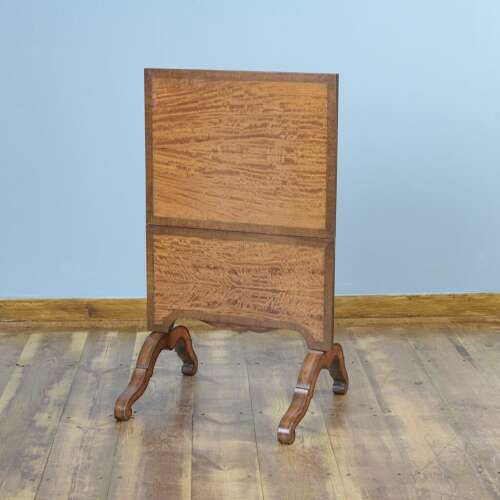
19th century satinwood inlaid folding tea table attributed to the renowned House of Giroux, Paris.
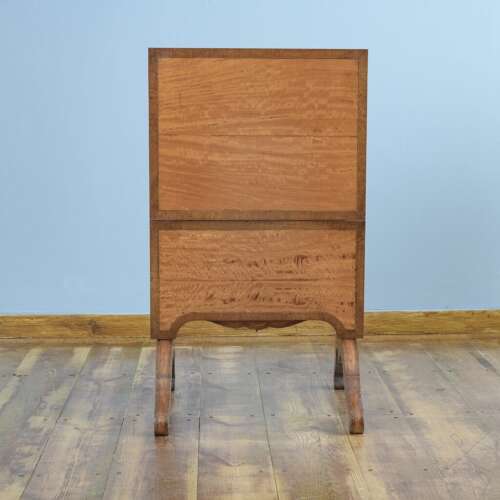
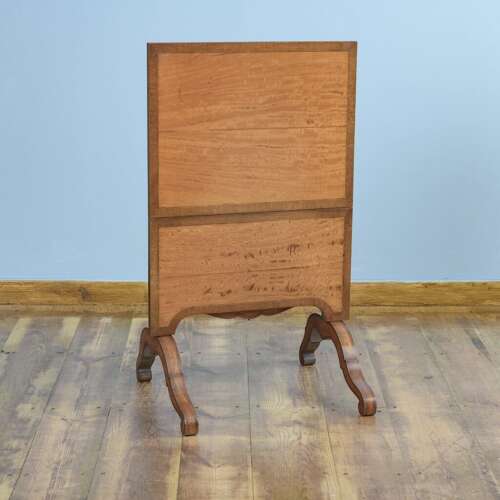
The rectangular top tier sits above the concave shaped tier, but both are made with book-matched satinwood veneers and crossbanded with mahogany, boxwood and ebony stringing. The gilt brass banded surrounds have been recessed and inset with engine turned upright flutes.
The tea table is metamorphic and collapses down to a flat decorative stand and, when used, the tiers are raised and supported on shaped solid mahogany lopers. The folding table is raised on a shaped base and the feet are typical of the Giroux name.
The design and model is known to be made by the 'Distinguished Firm of Maison Giroux'.
The V&A Museum have a Circular Tazza, that was made by the Parisian luxury company 'Maison Giroux' in their collection. I have listed a hyperlink below.
'Attributed to the House of Giroux' refers to items made by or associated with the French company Maison Alphonse Giroux, a renowned maker of luxury furniture, art, and accessories in Paris from the late 18th century into the 19th century. Items are 'attributed to' the house when they share the characteristic quality and style of the workshop, even if the specific artisan is not known, and the attribution is based on factors like materials, craftsmanship, and period design.
c1880
Dimensions
Height 81.00cm (31.89 inches)
Width 48.00cm (18.9 inches)
Depth 43.00cm (16.93 inches)
Scientific Name Chloroxylon swietenia (East Indian Satinwood) and Zanthoxylum flavum (West Indian Satinwood)
Geographic Origin East Indian variety from India and Sri Lanka; West Indian variety from the Caribbean and Florida
Classification Hardwood, dense and fine textured
Growth Cycle Slow growing, requiring 60 to 100 years to reach maturity
Primary Historic Usage Marquetry, crossbanding, decorative veneers, and high-end cabinet making during the Neoclassical period
Contemporary Status Limited availability; strictly controlled due to protected status and overexploitation
Introduction
Satinwood is a highly prized timber valued for its exceptional lustre and golden colour. It became a staple of the late eighteenth century cabinet making trade in Britain, particularly during the popularity of the Hepplewhite and Sheraton styles. The wood is renowned for its ability to reflect light, which gives the surface a luminous, silklike quality.
Appearance
The heartwood of satinwood is a pale golden yellow to a rich, deeper yellow brown. It is characterised by a natural sheen that intensifies with polishing. The grain is typically straight but can be interlocked, producing a variety of figures including mottle, ribbon, and roe. When quarter sawn, the wood displays a beautiful chatoyancy, where the light appears to move across the surface, contributing to the shimmering effect for which it is named.
Technical Characteristics and Workability
Satinwood is a dense, hard, and stable timber with a very fine and uniform texture. It is a pleasure to work with hand tools, taking a keen edge with ease and producing a smooth, high-quality finish. It glues well and accepts stains, oils, and polishes exceptionally well, often requiring very little preparation to achieve a high lustre. While it is stable once seasoned, it can be prone to checking if dried too rapidly.
Historical Context in the Furniture Trade
Satinwood reached the height of its popularity in Britain between 1770 and 1820. It was the favoured timber for the delicate, elegant furniture of the Neoclassical movement (c.1750-1850). Cabinet makers utilised it primarily for veneers, inlays, and crossbanding on mahogany or rosewood pieces, though entire cabinets and worktables of solid satinwood were also commissioned for the most opulent interiors. Its bright, reflective quality was used to contrast with darker timbers, adding visual interest to drawer fronts and tabletops.
Contemporary Trade and Sustainability
Due to extensive harvesting in previous centuries and slow regeneration rates, true satinwood is now rare in the commercial market. Large, clear planks are difficult to source, and much of the contemporary supply is limited to small quantities for specialist luthiers and high-end restoration projects. The trade of many Chloroxylon and Zanthoxylumspecies is now monitored to prevent further decline, making the acquisition of antique satinwood furniture a more sustainable and common way to appreciate this timber than sourcing new lumber.
Institutional References and Literature
The Wood Database (Eric Meier) Provides physical property data and identification characteristics for Chloroxylon swietenia.
The Dictionary of English Furniture Makers 1660 1840 (G. Beard & C. Gilbert) Discusses the widespread adoption of satinwood in late Georgian furniture design.
Forestry Commission Data (Kew Gardens) Documents the botanical distribution and conservation status of West Indian Satinwood species.
